The US wants to divide the world over AI: opinion
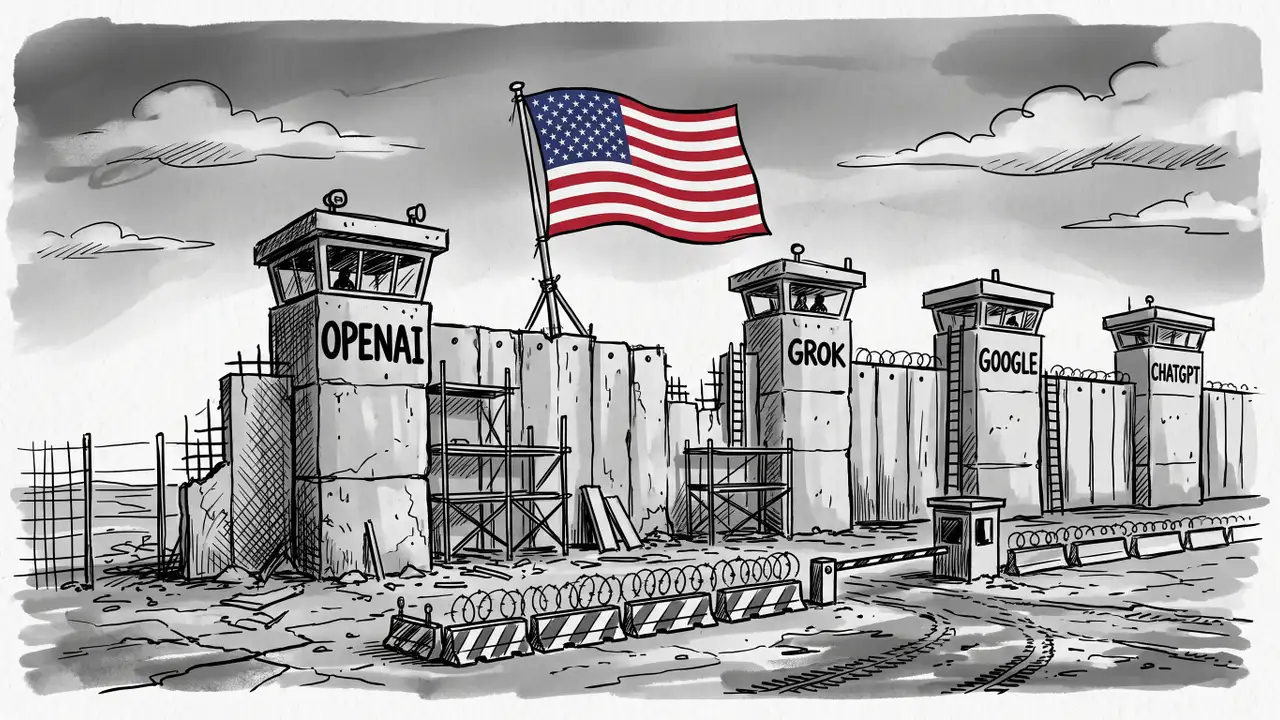
"You are with us or against us."
That was the message of a draft letter from the US State Department to 35 countries, as revealed by Reuters.
The letter relates to Artificial Intelligence and warns that joining cooperation frameworks led by other countries will result in exclusion from the US's own AI coalition.
The recipients are the 35 signatories of the US "Pax Silica" summit's AI Opportunities Statement from June. And the draft's wording is unequivocal:
RECOMMENDED FOR YOU

19 killed, 25 injured in Kolkata Durga Puja crowd crush
“To be part of everything is to be part of nothing. Signing the Pax Silica Declaration is not merely a membership subscription, but a commitment.”
Although the letter does not directly name China, it explicitly demands countries make a choice and prohibits joining initiatives that conflict with US positions.
An anonymous US official told Reuters the message is clear: "You cannot choose both."
The trigger for this ultimatum was Kazakhstan's attempt to stand on both sides.
In June, the US touted the mineral-rich nation as the first Central Asian country to join Pax Silica. However, Kazakhstan subsequently joined the World Artificial Intelligence Cooperation Organization (WAICO), a global intergovernmental AI organisation launched in Shanghai this July that currently boasts 29 founding members. This clearly crossed Washington's red line.
Ultimately, the US letter serves as a recruitment drive for a "de-Sinicized" supply chain alliance, attempting to expand Pax Silica into an exclusive bloc.
More than just software
Driven by Jacob Helberg, the US Deputy Secretary of State for Economic Growth, Energy, and the Environment, Pax Silica is not merely a software cooperation mechanism. It is a full-stack supply chain system covering critical minerals, energy, advanced manufacturing, semiconductors, computing power, data centres, and foundation models.
In a recent article titled "The Digital Sovereignty Trap," Helberg argued that countries building their own data, compute, and AI models will only cause resource waste and technological fragmentation. He advocates integrating national advantages through Pax Silica instead. The targeting of "digital sovereignty" is deliberate, contrasting sharply with China's stance.
RECOMMENDED FOR YOU

Europe's rainfall divide: Norway's coast receives over 3,000 mm while parts of Spain remain dry
At the 2015 World Internet Conference in Wuzhen, Chinese President Xi Jinping prioritised "respecting cyber sovereignty" and the right of nations to choose their own digital development paths.The US narrative objectively serves to maintain American corporate dominance in the global digital economy. By convincing other nations to abandon independent technology stacks, countries are forced to entrust their digital progression to US cloud providers and chip architects, leaving them in a state of technological dependency and vulnerable to supply chain disruptions.
The divide is mirrored in the business strategies of the leading US and Chinese providers. OpenAI and Anthropic's flagship models are closed: customers cannot access or modify the underlying weights, and processing is done in data centres controlled by the providers or their partners. Chinese firms such as Moonshot and DeepSeek release their models under open-weight licences, letting customers download them, run them on their own infrastructure and adapt them as needed.
Digital Iron Curtain
This bare-knuckle geopolitics has alarmed multinational corporations highly dependent on global supply chains. Siemens CEO Roland Busch recently warned in the Financial Times that escalating technological barriers threaten the global economy and could forge a "digital Iron Curtain" that stifles trade and progress.
He urged Europe to act as a bridge by promoting digital interoperability and unified standards. The real economy urgently needs an open, compatible global tech network, not forced alignment.
Washington’s rejection of digital sovereignty also extends to multilateral governance, notably the UN’s Global Digital Compact adopted in September 2024. The Compact advocates for sovereign regulatory rights, bridging the digital divide, and governing cross-border data flows. However, its respect for data localisation threatens the business models of tech giants relying on borderless data extraction. Furthermore, the UN’s egalitarian framework dilutes Washington's ability to unilaterally dictate industry standards, explaining the US's resistance to comprehensive multilateral digital regulation.
Faced with the formation of exclusive blocs, China has embraced a multilateral path. Beijing emphasizes that WAICO firmly supports the UN Global Digital Compact and rejects ideologically driven blocs. In practice, WAICO champions open-source foundation models and assists partners in building localized computing nodes based on engineering expertise in communications, advanced computing, and green energy. This allows nations to physically control their compute infrastructure and ensure data security, offering a space that balances technological progress with strategic autonomy.The US campaign to force supply chain realignment is fundamentally an attempt to consolidate its technological hierarchy at the dawn of the AI revolution.
Yet, artificially severing resource pipelines will undermine global economic resilience. Despite the differences, elements of agreement are still being found. At the November 2024 Lima summit, US and Chinese leaders reached a historic consensus confirming that humans, not AI, must maintain control over the use of nuclear weapons.
This milestone reminds the world that regardless of intense technological competition, global stability and the continuation of human civilisation still require dialogue and cooperation, rather than forcing the world to take sides.
RECOMMENDED FOR YOU
US tops Pakistan’s salt export markets by value
Yubin Du is a journalist, executive producer, and chief editor at CGTN. He was stationed in Washington, D.C., and London for six years each, focusing on US-China and EU-China relations. He has worked in international communications and digital media in China for over 16 years. This article represents the author's personal views. Contact the author at: [email protected]
This story is written and edited by the Global South World team, you can contact us here.
