This isn't a coal mine, it's a new way to think about energy
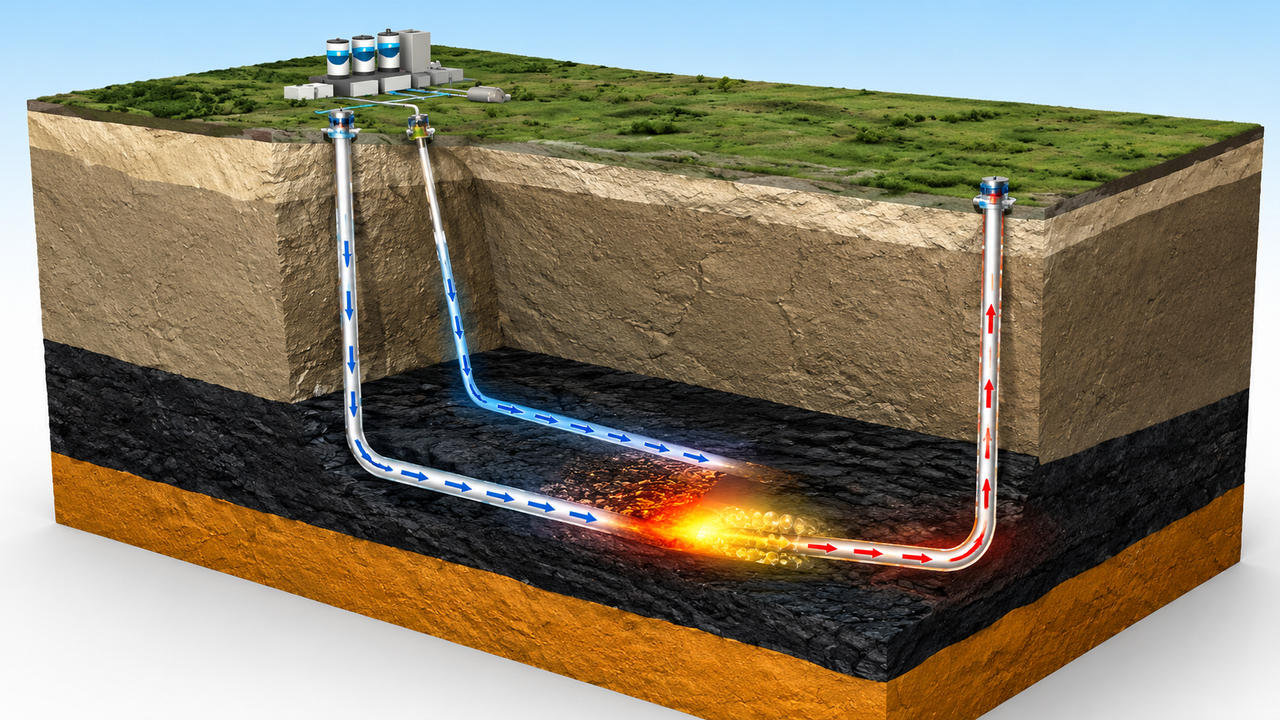
Underground coal gasification is not a cleaner way to burn coal. It is a different thing entirely. And the science backs that up.
Somewhere beneath the plains of South Australia, there is coal. A great deal of it. Deep seams, too far down to mine, too costly to reach by any conventional method. Under the old logic of the fossil fuel economy, that coal was simply written off. Stranded and unavailable — an asset nobody could touch without environmental, economic and human costs too high to justify.
Underground Coal Gasification — UCG — changes that logic. Instead of digging the coal out, it heats the coal where it lies and turns it into a valuable synthetic gas. Air or oxygen goes down one well, into the seam. The sSyngas comes back up a second well. No one needs to go underground. And the surface land is largely untouched.
The debate about coal’s place in the energy transition is too often viewed through an ideological lens: coal bad, renewables good, everything else a delay tactic. That’s not the real world. The International Energy Agency’s own projections suggest fossil fuels will meet around 80 per cent of global energy needs for at least the next forty years. Coal is a big slice of that. In many cases there isn’t any alternative to keep the lights on. If that is true, the real question is not whether the world uses coal. It is how. And on that question, UCG deserves far more attention than it gets.
What the Numbers Actually Say
RECOMMENDED FOR YOU

Nigeria investigates deaths of 37 suspected illegal miners in custody
Multiple independent lifecycle assessments provide the data points. UCG-based power generation emits about 28% less greenhouse gas over its full lifecycle than conventional pulverized coal combustion, the technology still running most of the world’s coal-fired plants. It’s the result of cutting out the dirtiest phases of the coal supply chain before they happen — this isn’t about carbon capture or offsets.
Those eliminated phases carry more weight than people assume. Blasting, hauling, crushing, conveying — mining coal burns a lot of energy before a single ton reaches a furnace. Add the diesel and bunker fuel spent moving coal by road, rail and sea to power stations thousands of kilometers away, and the gap widens further. Compare UCG directly against surface coal gasification and UCG needs 38.8 per cent less energy to produce the same output.
By exploiting the coal in the ground, UCG removes the mine, the transport chain, the coal stockpile, the fly ash lagoon, and the post-combustion flue gas treatment.
The land story is just stark. A conventional coal mine permanently reshapes the surface: removing overburden; piling up spoil; stacking up dams to hold the waste. All UCG leaves are drill pads. And the underground void it does leave behind can even be an asset. Studies in China put the potential CO2 storage capacity of UCG-created subsurface pores at somewhere between 29 billion and 102 billion tones, more again if fly ash infill is used. The mine that never existed can become a carbon sink.
The Air We Breathe
The story isn’t only about climate change or land disfigurement. The difference in air quality between UCG and conventional coal combustion is transformational. Burn coal at the surface and the products of combustion — particulate matter, Sulphur dioxide, nitrogen oxides, mercury — have to be cleaned up after the fact, through flue gas treatment that is expensive and never quite complete. The smallest particles, PM2.5 and PM10, slip through even well-maintained filters and end up in the lungs and bloodstreams of people who live near the plant. A Harvard study put the cost of fossil fuel air pollution at around 8.7 million premature deaths a year.
UCG syngas is cleaned before anyone burns itthem. Sulphur and nitrogen compounds and nitrogen oxides come out upstream, at the gas processing facility, more efficiently and more cheaply than any post-combustion system can manage. By the time the gas reaches a power station or a chemical plant, its air quality profile looks like natural gas, not coal. Particulate emissions at the point of combustion are negligible. Fly ash does not exist, because there is no surface combustion left to produce it.
A lifecycle endpoint assessment comparing UCG with Integrated Gasification Combined Cycle technology found UCG produced 23 per cent lower ecosystem quality impacts, 15 per cent lower human health impacts, and 4 per cent lower resource depletion impacts.
RECOMMENDED FOR YOU

Sovereignty dominates biggest ever BRICS summit in India
A Bridge with Its Own Exit Built In
The United Nations Department of Economic and Social Affairs recognized UCG’s potential as far back as 2007, when it convened a capacity-building workshop in Almaty, Kazakhstan. Governments, research institutes and industry from ten countries attended, including Australia, China, India, Canada and the United States. The resulting Almaty Concept Note described UCG as enhancing “flexibility in the transition to a low-carbon energy economy,” and noted that its product gas “easily lends itself to CO2 removal by a range of standard methods, with low energy penalty and at a relatively low cost.” [6]
That line points to UCG’s most useful environmental feature: it was built for carbon capture. In conventional coal combustion, CO2 sits diluted at low pressure inside the flue gas, expensive to separate. In UCG, CO2 comes out of the syngas stream concentrated and under pressure, which makes capturing it before combustion straightforward and cheap. Couple UCG with carbon capture and storage, and its lifecycle greenhouse performance has been shown to beat natural gas-based steam methane reforming with CCS. Near-zero emissions from UCG are not a theoretical hope. It is an engineering achievement.
UCG also opens industrial decarbonization routes that conventional coal simply cannot offer. In fertilizer manufacturing, Fischer-Tropsch synthesis, and synthetic methane production, pulling CO2 out of UCG syngas is a routine step in the process.
The Choice Was Never Coal or No Coal
The energy transition will not happen overnight. It will take decades, and for all those decades the coal already in the ground will remain a resource that governments, investors and communities want to use. The real question is whether they use it the most destructive way available — open-cut mining, rail transport, pulverized combustion, flue gas scrubbing, ash lagoon disposal — or the way the evidence consistently says is better, across every measure that matters.
UCG development does not require anyone to love coal. It simply requires honesty about the difference between digging coal up and leaving it exactly where it is, while still drawing out its energy from a distance.
The distinction is clear: twenty-eight per cent less greenhouse gas from UCG than conventional coal combustion. Thirty-nine per cent less energy than surface gasification. Zero surface mining. Near-zero particulates. Pre-combustion CO2 captured cheaply. Underground voids suitable for permanent carbon storage. And the ability to pull energy out of coal seams too deep, too thin or too poor for any mine to ever reach, without paying the environmental price of trying.
RECOMMENDED FOR YOU

Women risk lives for coal as fuel crisis bites in Bangladesh: Video
That is not the case for fossil fuels. It is a case for benefitting from coal where it lies: under the plains of South Australia, Brazil, USA, China or everywhere else like it.
The author is an expert in energy and natural resources who has advised governments and major corporations across the world on strategy and policy. He requested to remain anonymous owing to the nature of his ongoing work.
