US Senate election 2026: Democrats lead in seven closely contested races as control hangs in balance
Key points
- Democrats are favoured in 48 seats and Republicans in 45.
- Seven Senate races remain too close to call.
- Democrats lead narrow polling averages in Texas, Alaska and Iowa.
Control of the US Senate remains uncertain ahead of the November 3 midterm elections, with seven races rated toss-ups and Democrats holding narrow polling leads in several states traditionally favourable to Republicans.
An October 19 election forecast published by US Elections and The World in Maps, using Race to the White House averages, places 48 Senate seats in the Democratic column and 45 in the Republican column, leaving seven undecided.
The projections include seats not being contested this year and are not election results. A total of 35 Senate seats are up for election in 2026.
Seven states could decide Senate control
The forecast identifies Alaska, Iowa, Kansas, Maine, Nebraska, Ohio and Texas as toss-ups.
RECOMMENDED FOR YOU

G7 economy remains far larger than BRICS in nominal GDP despite China’s rise
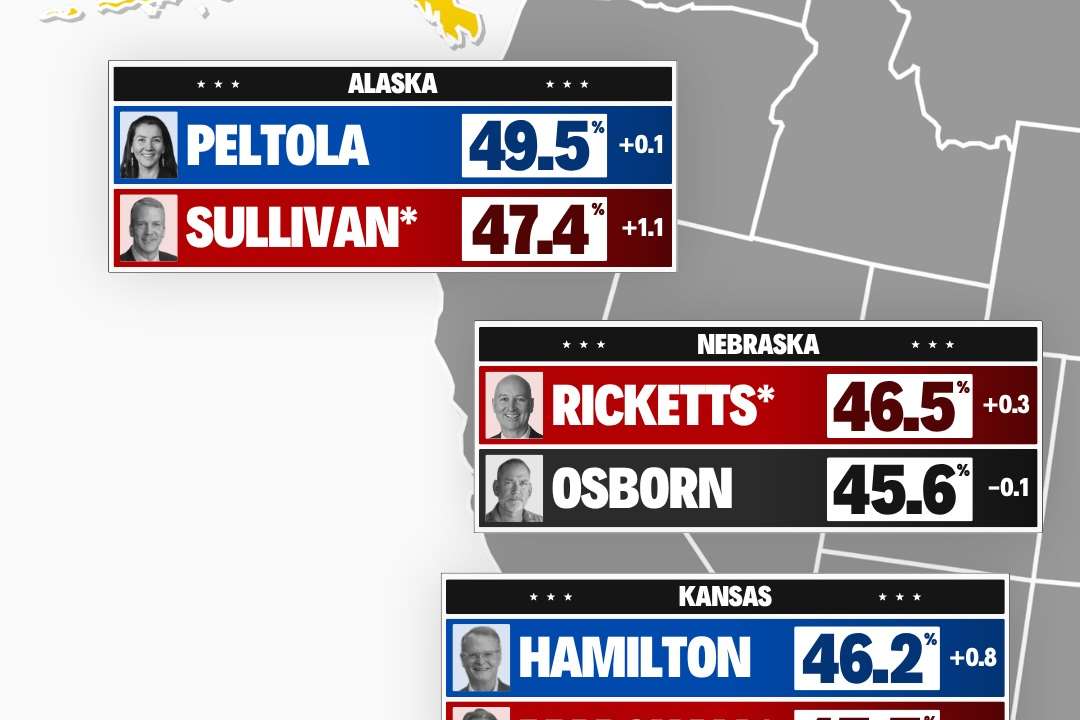
In Alaska, Democrat Mary Peltola leads Republican Senator Dan Sullivan by 49.5% to 47.4%, according to the October 19 averages.
Texas also shows a narrow Democratic advantage, with James Talarico polling at 48.3% against Republican Ken Paxton's 46%.
In Iowa, Democrat Zach Wahls Turek is shown ahead of Republican Ashley Hinson by 46.1% to 45.7%.
The margins are small, however, and polling averages can change before election day.
Michigan and Minnesota lean Democratic
Democrats also lead in two closely watched Midwestern contests.
In Michigan, Abdul El-Sayed is polling at 47.9%, compared with 44.9% for Republican Mike Rogers. Minnesota's Peggy Flanagan holds a wider advantage over Republican Michele Tafoya, leading 46.7% to 42.9%.
The forecast also shows tight races in Kansas and Nebraska. Democrat Adam Hamilton leads Republican Senator Roger Marshall by 46.2% to 45.5% in Kansas, while Republican Senator Pete Ricketts leads independent Dan Osborn by 46.5% to 45.6% in Nebraska.
These are polling estimates rather than confirmed voting intentions, and other polling averages show slightly different margins.
RECOMMENDED FOR YOU

Brazil votes on October 4 with its economic future and the Amazon at stake
Democrats face a difficult path to a majority
Republicans currently control the Senate, meaning Democrats must gain enough seats to reach 51 for an outright majority. A 50–50 split would allow Republican Vice President JD Vance to cast tie-breaking votes.
Independent candidates could complicate the calculations, particularly in Nebraska, where Osborn is running without a major-party affiliation.
With two weeks remaining before election day, both parties are concentrating resources on competitive states. President Donald Trump campaigned in Kansas on October 19 to support Marshall, whose re-election contest has become unexpectedly competitive.
The October 19 map suggests that neither party has secured control. The outcome will depend on a small number of close races where even modest changes in voter support could alter the Senate's balance of power.
This story is written and edited by the Global South World team, you can contact us here.