A newly discovered cobra specie that may already be extinct
Science is a captivating field characterized by a continuous stream of groundbreaking discoveries.
Dedicated scientists and researchers are tirelessly in pursuit of novel insights, uncovering fresh perspectives on established knowledge, and effectively addressing complex challenges. Recently, a noteworthy breakthrough was achieved by a team of researchers, adding to the ever-expanding realm of scientific knowledge.
Tom Major, a Postdoctoral Research Fellow at Bournemouth University, Axel Barlow, Lecturer in Zoology at Bangor University and Wolfgang Wuster a reader in Zoology at Bangor University harnessed advances in DNA extraction techniques to study a snake from the Eastern Highlands of Zimbabwe.
The snake, believed to have been initially documented by early scientists in 1920, has been housed in a Zimbabwean museum for approximately four decades.
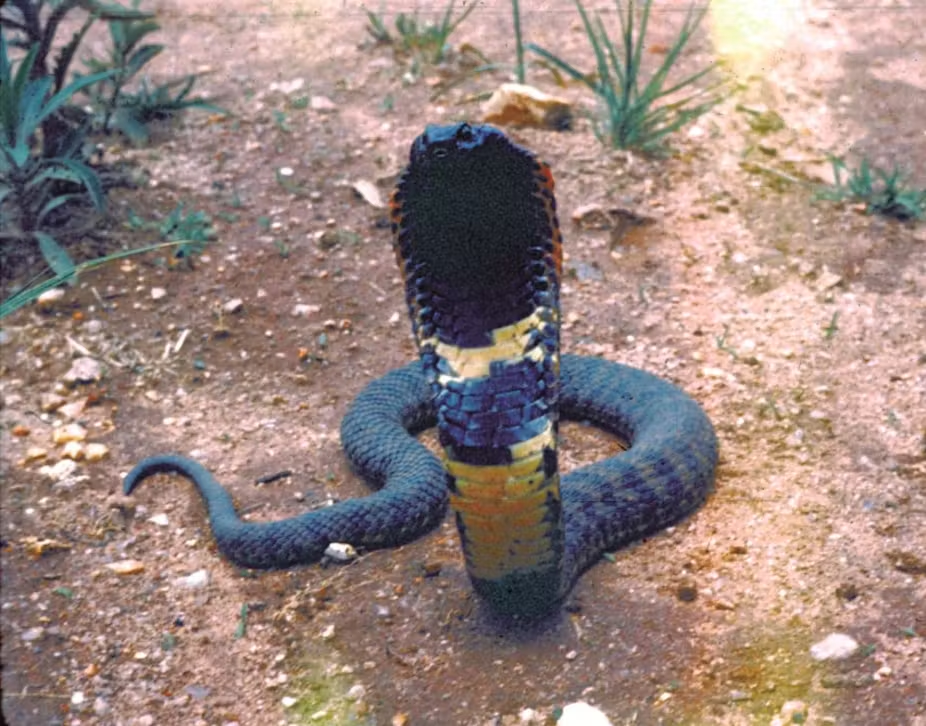
This unique serpent, named the Nyanga rinkhals, is reported by researchers to exhibit a defensive hooding posture reminiscent of a cobra.
RECOMMENDED FOR YOU

Six countries account for three-quarters of Europe’s unicorn startups
“The snake had unusual markings with red skin between its scales, creating the effect of black dots on a red background when its hood is extended,” parts of the research titled 'Museum DNA reveals a new, potentially extinct species of rinkals from the Eastern Highlands of Zimbabwe' noted.
DNA analysis done by the research team revealed that the snakes represent a long-isolated population and can be classified as a new species, Hemachatus nyangensis, the Nyanga rinkhals.
The scientific name nyangensis translates to “from Nyanga” in Latin.
The rinkhal species has fangs modified to spit venom like the cobra does when they sense threats.
Although other species of rinkhals like the (Hemachatus haemachatus) have been discovered by Donald G. Broadley now considered to be the most eminent reptile and amphibian expert of Southern Africa in areas like South Africa, Eswatini (formerly known as Swaziland) and Lesotho, the Nyanga rinkhals appears to have different features.
The rinkhals from Zimbabwe are feared to be extinct, the rare snakes have not been spotted in the wild since 1988.