What Europe’s countries are called in Irish
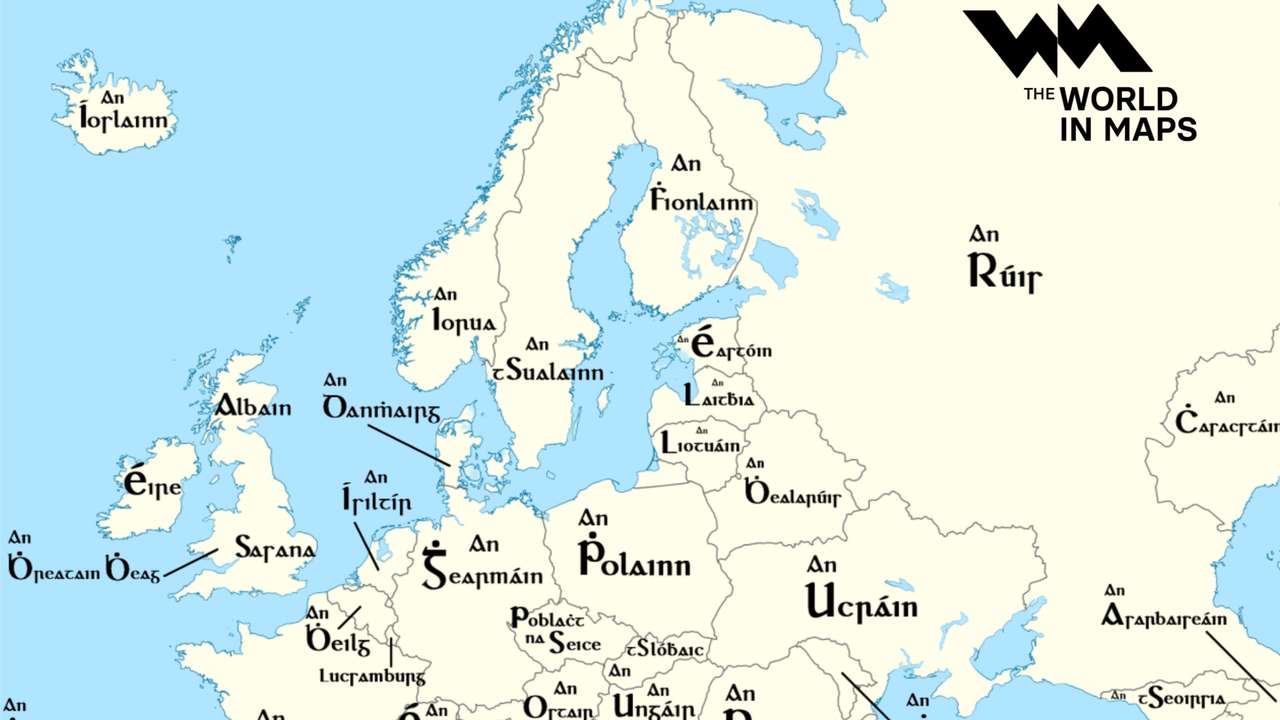
France becomes An Fhrainc, Germany is An Ghearmáin and Spain is An Spáinn. A map of Europe labelled entirely in Irish shows how familiar country names can look and sound very different when viewed through another language.
Key points
- European country names change in Irish
- Many names take the article An
- Irish has full official EU status
France becomes An Fhrainc, Germany is An Ghearmáin and Spain is An Spáinn. A map of Europe labelled entirely in Irish shows how familiar country names can look and sound very different when viewed through another language.
Other examples include An Iodáil for Italy, An Pholainn for Poland, An Úcráin for Ukraine, An Rómáin for Romania, An Ghréig for Greece and An Rúis for Russia.
Some are much easier for English speakers to recognise. Portugal is An Phortaingéil, Finland is An Fhionlainn and Iceland is An Íoslainn. Others, including Éire for Ireland and An Eilvéis for Switzerland, look considerably different from their English equivalents.
Why so many names begin with ‘An’
One feature quickly stands out: a large number of Irish country names begin with “An”, the Irish definite article, broadly equivalent to “the” in English.
RECOMMENDED FOR YOU

Asia and Europe dominated the world’s biggest cities in 1700
But it is not simply a matter of putting An before an English country name. Irish has its own established geographical vocabulary and grammatical rules. The article can also trigger changes to the beginning of the following word, helping explain forms such as An Fhrainc, An Ghearmáin and An Pholainn.
Not every country takes the article. Éire, Sasana for England and Albain for Scotland are examples that normally appear without it.
The map also uses Irish names for countries beyond the European Union, including An Tuirc for Türkiye and An Rúis for Russia. It is therefore a linguistic map of European countries rather than a map of EU members.
Irish is one of the EU’s 24 official languages
Irish is the first official language of Ireland under the Irish Constitution, while English is recognised as a second official language. At the European level, Irish became an official and working language of the European Union in 2007.
Its status initially came with a temporary exemption that meant EU institutions did not have to translate every document into Irish. That derogation ended on January 1, 2022, putting Irish on the same footing as the EU's other official languages. The bloc currently has 24 official languages.
The change means Irish is now used across EU legislation, translation and interpretation alongside languages spoken by much larger populations. Ireland's 2026 EU Council presidency is its first since Irish gained full official and working status, with the government arranging Irish interpretation for ministerial meetings and summits held during the presidency.
The map ultimately offers more than translations of familiar names. It shows how geography changes when viewed through a different language: France, Germany and Greece remain in exactly the same places, but in Irish they become An Fhrainc, An Ghearmáin and An Ghréig.