Global ageing trends: UN report reveals median age by region in 2025
The world’s population is ageing at an unprecedented pace, but this trend is far from uniform across different parts of the globe. According to the United Nations’ World Population Prospects 2024 (the UN’s latest population report), the median age – the age at which half the population is older and half younger – reached about 31 years globally in 2025.
This is a sharp increase from around 22 years in 1950, reflecting decades of rising life expectancy and falling birth rates worldwide. However, a closer look at regional age comparison data reveals striking disparities: some regions remain very young, while others are greying rapidly. Below, we explore the median age by world region in 2025 and the historical trends since 1950.
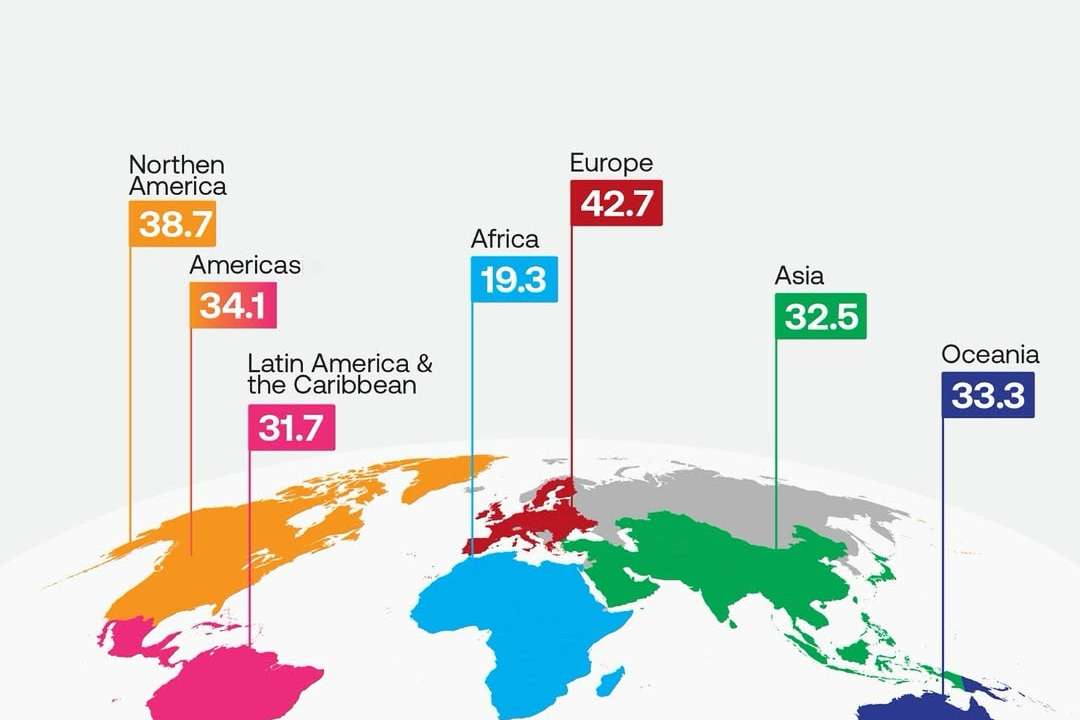
The median ages in 2025 vary widely by region. Africa stands out as the world’s youngest region with a median age of only 19.3 years. In a sharp contrast, Europe has a median age of 42.7 years, making it the oldest region globally.
In other words, the typical European is more than twice as old as the typical African – a demographic divide shaped by differences in fertility and longevity. Most other regions fall somewhere between these extremes. Asia’s median age is about 32.5 years, very close to that of Latin America and the Caribbean (around 31.7 years in 2025).
RECOMMENDED FOR YOU

Egypt's el-Sisi warns of 'catastrophic' consequences if US-Iran conflict resumes
Oceania (which includes Australia, New Zealand, and the Pacific Islands) has a median age of roughly 33.3 years. In the Western Hemisphere, the Americas overall have a median age of approximately 34.1 years, but this too masks regional differences.
North America (primarily the United States and Canada) is older, with a median age of about 38.7 years, whereas Latin America is younger (as noted, around 32 years). These numbers, drawn from the UN’s 2024 population report, highlight how some continents are significantly “younger” or “older” than others in 2025.
Trends from 1950 to 2025
The difference in 2025 median ages did not happen overnight – it’s the result of decades of demographic change. Global median age has been climbing for generations, rising from about 22 in 1950 to roughly 30 today, and it is projected to reach around 42 by the year 2100.
This steady upward creep reflects the overall ageing of the world’s population, driven by longer life expectancies and, especially, declines in birth rates. Yet, the pace of ageing has differed greatly by region. For instance, Europe’s median age was around the late 20s in the mid-20th century; today it has surpassed 40 years.
That means Europe has gained well over a decade in median age as families there became smaller and people lived longer. In contrast, Africa’s median age has nudged up only slightly – it was roughly 16–17 years in the 1950s and remains under 20 years even now.
Other regions have followed intermediate trajectories: Asia and Latin America, for example, had very youthful age structures in 1950 (median ages likely in the early 20s) but have since aged into the 30s as development accelerated and fertility dropped.
The United Nations data confirm that every region is older on average today than in past decades, but regions that started with higher median ages (like Europe) continued to age rapidly, while those that began very young (like Africa) are only slowly starting to grey.
This story is written and edited by the Global South World team, you can contact us here.