How New Asia could shape the world’s halal standard
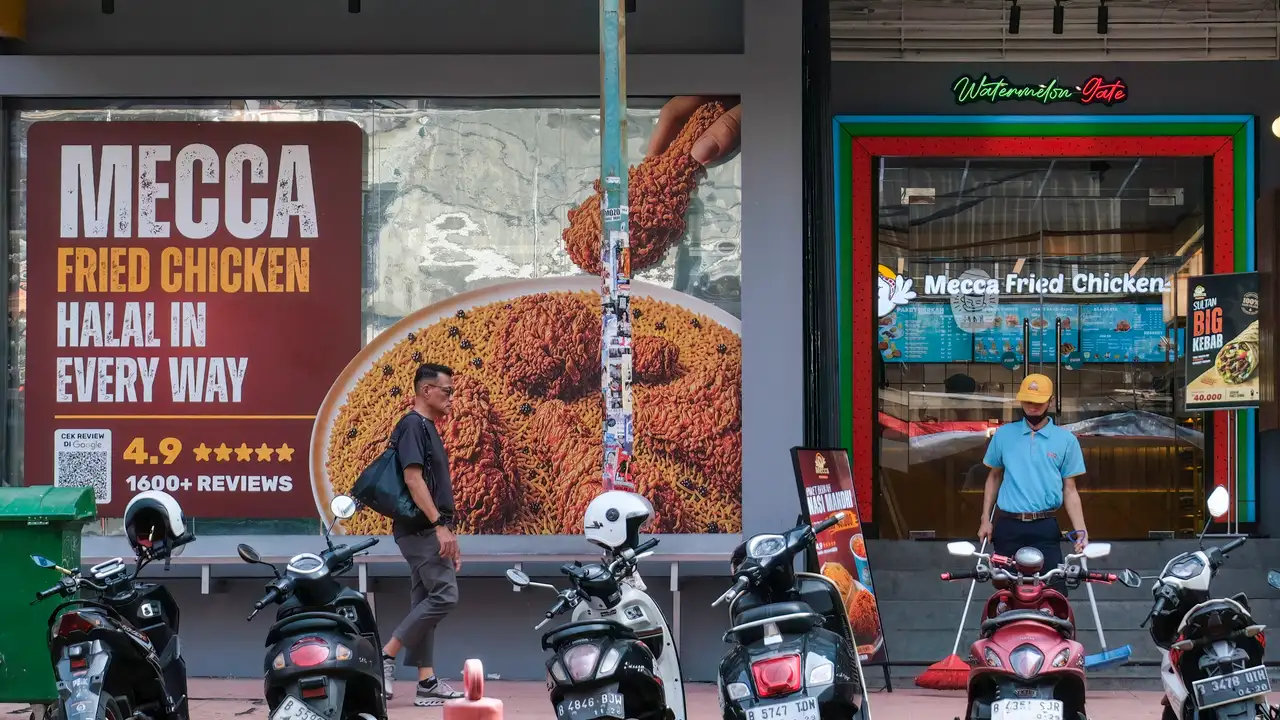
Indonesia and Malaysia have started to bring their halal certification systems together. If the rest of ASEAN follows, the region could set the standard for a global halal food market worth about US$1.5 trillion a year.
Southeast Asia is home to the world's largest halal food market and to the country that has led the global Islamic economy rankings for 12 years. What it does not yet have is a single way of certifying halal products. That is starting to change, and the result could shape how halal food is traded around the world.
Indonesian consumers spent US$165.4 billion on halal food and drink in 2024, more than any other country, according to DinarStandard's State of the Global Islamic Economy Report. The same report ranks Malaysia first on its Global Islamic Economy Indicator for the 12th year in a row.
Muslim consumers worldwide spent about US$1.5 trillion on food in 2024, a figure DinarStandard expects to reach about 2.1 trillion by 2029. Yet halal rules are still set country by country. A food company selling to Indonesia, Malaysia and Saudi Arabia deals with three regulators, BPJPH, JAKIM and the Saudi Food and Drug Authority, each with its own certification system.
A unified process across New Asia would allow a product certified once to be sold across the region. With the two largest halal economies in Southeast Asia at its core, it could also become the benchmark for other markets around the world.
RECOMMENDED FOR YOU

'All these governments have the same aim': a Palestinian perspective on Israel's settler expansion
The building blocks are in place
The first steps have been taken. In April 2025, Malaysia agreed to recognise Indonesian halal certification, and Indonesia agreed to accept products carrying Malaysia's JAKIM halal logo without a separate procedure. In September 2026, the two countries announced a joint halal council, the Malaysia-Indonesia Halal Council (MINDHaC), to cut duplicate certification on trade between them, with Indonesia's Halal Product Assurance Agency (BPJPH) as chair and Malaysia's Department of Islamic Development (JAKIM) as secretariat.
The joint council is designed as the foundation for an ASEAN Halal Council, which Malaysia aims to launch by September 2027. The Philippines, which chairs ASEAN in 2026, is working on harmonised halal guidelines across the bloc. ASEAN's 11 members have a combined population of more than 680 million, about 45% of whom live in Muslim-majority member states.
A regional system will need more than a council. Members will have to agree on common certification criteria, decide which certification bodies qualify, keep a shared register of approved companies and products, and settle how audits and cases of non-compliance are handled. Indonesia's agreement with Saudi Arabia, signed in October 2023, offers a template. It covers mutual recognition of halal certificates for exports, conformity assessment procedures, standards and technical regulations, and joint work on training, research and laboratory testing.
Room for the industry to grow
For manufacturers, one certificate across New Asia would mean faster product launches and wider distribution. PT Aik Cheong Indonesia makes products in Malaysia for sale in Indonesia, and each new product currently has to be registered and certified with BPJPH before it can be sold.
"With harmonisation in place, products manufactured at Aik Cheong's factory in Malaysia could potentially be distributed more quickly and widely in Indonesia," said Randy Rahtomo, the company's director.
He expects the gains to grow as the framework widens. "If the market extends beyond each country, sales and sales volumes will certainly be stronger. This will increase revenue, which in turn leads to profitability," Rahtomo said.
Mohammad Faisal, executive director of the Centre of Reform on Economics (CORE) Indonesia, argues that a bigger market should be a means to build industry in the region. "If the title is one market, what about the production hubs? In the context of ASEAN, we have actually wanted ASEAN to become a single market for a long time. And production hubs are not just about markets; they are also about building supply chains within ASEAN," he said.
A common certification process makes those supply chains easier to build. Companies could specialise in particular products or stages of processing, buy ingredients from neighbouring countries and sell finished goods across the region. That scale matters, because ASEAN producers compete with large established exporters in their own markets. Australia supplied 60.2% of the US$862.3 million of fresh and processed meat that Indonesia imported in 2024, according to Agriculture and Agri-Food Canada.
RECOMMENDED FOR YOU
Who is Zanetor Agyeman-Rawlings, the Ghanaian minister who challenged COP31 president?
Quality, safety and stability
A common standard is also a chance to raise quality. "If a product has halal certification, the industry should have a competitive advantage in terms of product quality. So it should not only be halal under Islamic law, but also be of better quality," Faisal said.
Halal status on its own does not guarantee that food is safe. A regional framework that ties halal certification to shared food safety checks, traceability and animal welfare rules for livestock handling and slaughter would give consumers more confidence and give regulators one system to enforce.
Supply chains that run across several New Asia countries are also less exposed to a poor harvest, a disease outbreak or a disruption to imports in any single market. That makes regional integration part of the case for food security.
Certification also has to be within reach of small producers. A research note published through CEPR's Private Enterprise Development in Low-Income Countries (PEDL) program surveyed the poultry slaughtering supply chain around Jakarta and found that 74.1% of downstream businesses had no halal certification, citing uncertain costs, complicated procedures and a lack of information. A unified system that is simpler and cheaper to use would bring more of them into the formal halal market.
A standard for the world
Once ASEAN has its own rules, it can help shape a global benchmark, working with partners such as Saudi Arabia. Work is already underway. The two agencies began coordinating in October, and on 10 November 2026 they agreed a concept paper for MINDHaC, which JAKIM will now put to Malaysia's Cabinet. The ASEAN Halal Council is targeted for September 2027. If member states agree rules that are rigorous and simple to use, ASEAN will be in a position to set the terms for the global halal industry. Food and agribusiness investment is on the program at New Asia Forum, which convenes in Bali on 3 and 4 December 2026.
New Asia Forum is New Asia's annual investment platform. It is powered by Danantara Indonesia and produced by Richard Attias & Associates.
New Asia Forum. Gateway to the New Asia. Where Vision is Invested. Request an invitation
RECOMMENDED FOR YOU

The campus boom: New Asia brings the university home
